Inconel 625 is a nickel-chromium-molybdenum alloy widely used for its excellent corrosion and oxidation resistance at high temperatures. Poudre d'inconel 625 enables manufacturing components from this alloy using advanced powder metallurgy techniques.
This guide covers Inconel 625 powder compositions, properties, production methods, particle characteristics, applications, advantages, limitations, pricing, and comparisons with alternative alloys.
Introduction to Inconel 625 Powder
Inconel 625 powder has the following key characteristics:
- Made of Nickel-Chromium-Molybdenum alloy
- Contains Ni-Nb strengthening precipitates
- Excellente résistance à la corrosion
- High strength and toughness
- Stable at temperatures up to 980°C
- Available in various size distributions
- Mainly used for additive manufacturing
- Also suitable for MIM, thermal spray, welding
The properties of Inconel 625 make it well-suited for parts exposed to extreme environments. The powder form enables manufacturing complex geometries using advanced methods.
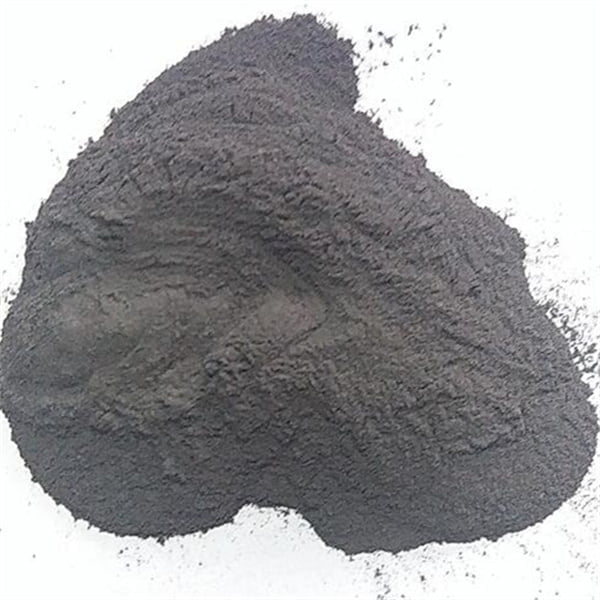
Composition typique des Poudre d'Inconel 625
The nominal composition of Inconel 625 powder is:
Composition de la poudre d'Inconel 625
| Élément | Poids % |
|---|---|
| Nickel | 58.0 min |
| Chrome | 20.0-23.0 |
| Molybdène | 8.0-10.0 |
| Niobium | 3.15-4.15 |
| Le fer | 5.0 max |
| Cobalt | 1,0 max |
| Aluminium | 0,4 max |
| Titane | 0,4 max |
| Carbone | 0,1 max |
- Nickel provides corrosion resistance and ductility
- Chromium for oxidation and pitting resistance
- Molybdenum and Niobium for strengthening
- Controlled low impurities for reliable performance
The balanced alloy composition provides a combination of fabricability, weldability, and high temperature properties.
Properties and Characteristics of Inconel 625 Powder
Propriétés physiques
- Density: 8.44 g/cm3
- Melting point: 1260-1350°C
Propriétés mécaniques
- Tensile strength: 760 MPa
- Yield strength: 380 MPa
- Elongation: 40%
- Fatigue strength: 300 MPa at 107 cycles
Propriétés à haute température
- Retains tensile strength upto 980°C
- Excellent creep rupture strength
- Good metallurgical stability
Propriétés de corrosion
- Highly resistant to pitting and crevice corrosion
- Excellent chloride ion stress corrosion cracking resistance
- Resistant to oxidation and carburization
Production Methods for Inconel 625 Powder
Key techniques for producing Inconel 625 powder include:
- Atomisation des gaz – High pressure inert gas breaks up molten alloy stream into fine droplets. Most common method.
- Atomisation par plasma – Very high temperatures from plasma torches produce finer powders.
- Procédé à électrodes rotatives – Centrifugal forces disintegrate molten metal into droplets.
- Atomisation de l'eau – Less common due to contamination risks.
Gas atomization allows cost-effective production of Inconel 625 powder with controlled particle sizes and minimal contamination.
Caractéristiques des particules de Poudre d'Inconel 625
Morphologie des particules
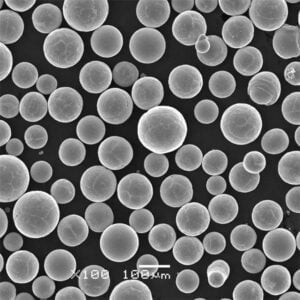
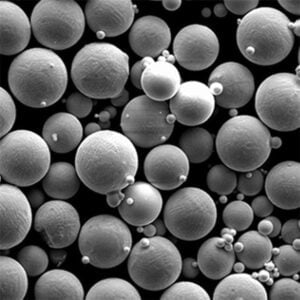
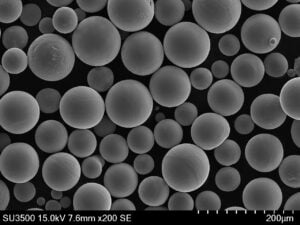
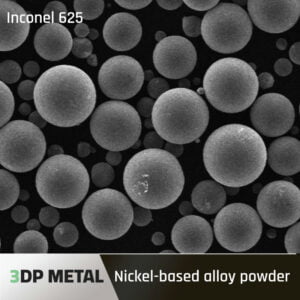
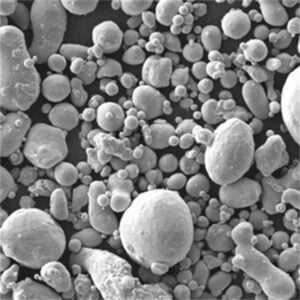
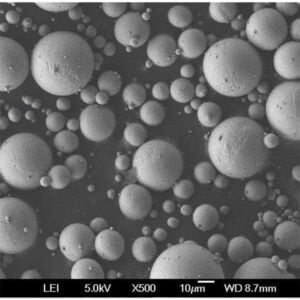
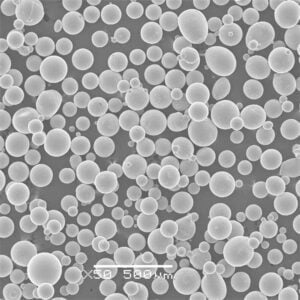
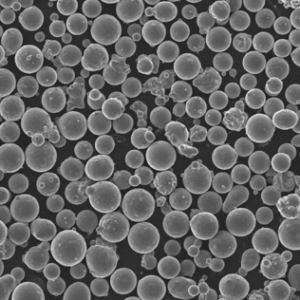
- Predominantly spherical particles
- Satellites can be removed by thermal conditioning
Distribution de la taille des particules
- Typical size ranges from 15 to 150 microns
- Narrow distribution ensures density and quality
- Smaller sizes used for better resolution
Propriétés d'écoulement
- Poudres généralement fluides
- Flow rates measured by Hall flowmeter test
Composition chimique
- Conforms to Inconel 625 nominal alloy content
- Low oxygen and nitrogen levels
- Meets chemical specification standards
Control over particle characteristics is critical for achieving required properties in finished components.
Applications de la poudre d'inconel 625
Key application areas of Inconel 625 powder include:
Fabrication additive
- Composants aérospatiaux
- Turbine hot section parts
- Pièces du système d'échappement
- Pièces de manipulation de fluides résistantes à la corrosion
Moulage par injection de métal
- Small, complex components
- Corrosion resistant valves
Revêtements par pulvérisation thermique
- High temperature corrosion protection
- Wear resistant coatings
Soudage
- Corrosion resistant weld overlays
- Similar composition filler metal
The unique properties of Inconel 625 allow manufacturing high performance components for demanding applications via powder metallurgy techniques.
Benefits and Advantages of Poudre d'Inconel 625
Key advantages of using Inconel 625 powder:
- Excellent resistance to wide range of corrosive environments
- Maintains high strength at elevated temperatures
- Retains metallurgical stability upto 980°C
- High fatigue, creep and rupture strength
- Crack, pitting and crevice corrosion resistance
- Oxidation and carburization resistance
- Narrow melting range improves weldability
- Powder form enables additive manufacturing
- Allows manufacturing of complex, net-shape parts
- Components can be engineered with superior properties
- Economical compared to other Ni-alloys
The performance benefits of Inconel 625 combined with design flexibility make it an attractive alloy for critical applications.
Limites et inconvénients
Some limitations of using Inconel 625 powder include:
- High material costs compared to steels
- Poorer mechanical properties than latest Ni-alloys
- Lower strength than high carbon alloys
- Nécessite un pressage isostatique à chaud pour obtenir une densité maximale
- Prone to micro-fissuring in some builds
- Un post-traitement peut être nécessaire
- Controlling particle characteristics adds cost
- Suitability testing needed for new applications
- Requires handling precautions due to fine particles
The limitations can be overcome with proper parameter selection and testing for each application.
Prix de la poudre d'Inconel 625
Inconel 625 Powder Price Ranges:
- 15-45 microns: $50-$65 per kg
- 45-75 microns: $45-$55 per kg
- 75-150 microns: $40-$50 per kg
- Pricing depends on particle size, quality, quantity ordered
- Nécessite des matières premières d'une grande pureté, ce qui augmente les coûts
- Processing costs more than nickel/steel powders
- Still economical for high performance applications
For suitable applications, Inconel 625 powder provides long term value despite higher initial costs.
Comparison with Alternative Alloy Powders
Compared to Inconel 718 Powder
- Inconel 625 has better corrosion resistance
- Higher service temperature capability
- Lower strength and hardness than IN718
- IN718 has higher tensile and fatigue strength
Compared to 316L Stainless Steel Powder
- Inconel 625 has far superior high temperature strength
- Much better corrosion resistance
- Higher costs than 316L powder
- 316L has better weldability and ductility
Compared to Cobalt Chrome Powder
- Inconel 625 has higher ductility and fracture toughness
- Poor wear resistance relative to cobalt alloys
- Significantly lower cost than cobalt chrome
Inconel 625 provides the best combination of properties for applications where corrosion resistance with intermediate temperature properties are needed.
FAQ
Q: How is Inconel 625 powder produced?
A: Gas atomization is the most common method. The alloy is induction melted and disintegrated into fine droplets using inert gas jets. The droplets solidify into powder.
Q: What particle sizes of Inconel 625 powder are available?
A: Typical size ranges are 15-45 microns, 45-75 microns and 75-150 microns. Finer powders provide better resolution but cost more. Size distribution affects final part properties.
Q: What applications use Inconel 625 powder?
A: Key applications are additive manufacturing of aerospace, gas turbine and corrosion resistant parts. Also used in metal injection molding, thermal spray, and for welding wire.
Q: What are the benefits of Inconel 625 vs stainless steels?
A: Inconel 625 has far superior high temperature strength and corrosion resistance compared to stainless steels. It is widely used for demanding applications.
Q: Does Inconel 625 powder require hot isostatic pressing?
A: HIP helps achieve full density and optimal properties. Critical components are often HIPed post additive manufacturing. For some applications sintering alone may suffice.
Q: How to minimize micro-fissuring when printing Inconel 625?
A: Optimizing build parameters, using spherical powders, HIPing, and stress-relieving heat treatments can minimize micro-fissuring issues.
Q: What precautions are necessary when handling Inconel 625 powder?
A: Use dust masks, gloves, and protective clothing to prevent inhalation or skin exposure during handling. Follow recommended safety protocols for metal powders.
Q: Is Inconel 625 weldable?
A: Yes, matching filler material provides good weld joint properties. Controlled processes are used to manage residual stresses and cracking.
Q: Is Inconel 625 powder reusable?
A: Unused powder can be reused after sieving to remove large particles. But reuse may introduce defects so fresh powder is generally recommended.